Blog
Nerd level Mild peril (level 2 of 3)
Something Big Is Coming
Bond markets, data centres, disappearing game discs, rogue AI agents, a chip company in crisis, and protests in a dozen countries look unconnected. Followed back far enough, they tell one story.
In the first ten days of November, three things happened that looked unrelated. On the 5th, the Bank of England raised interest rates for the first time in more than three years. The same day, the Nasdaq, America’s technology-heavy stock index, fell 5.5%, its worst day since April 2025. And on the 8th, the chief executive of Nvidia, the company that makes most of the chips the AI boom runs on, told his staff he had been unfaithful to his wife.
Each of those has its own explanation, and I’ll come to them. But I’ve spent the last few weeks reading about stories like these, from bond markets and data centres to police cameras, game discs, rogue AI, and protests in a dozen countries. The more I read, the less unrelated they looked. Followed back far enough, I think they’re one story. This is my attempt to tell it, and it starts with the price of money.
The money
For most of the last thirty years, borrowing got cheaper. The interest rate on long-term government debt in Britain and America fell, with bumps, from around 8% in the mid-1990s to well below 2% by 2020. A generation of homeowners, governments, and companies got used to money that cost almost nothing.
That ended in 2021, and this autumn it got worse. On 7 October, the rate on Britain’s 30-year government debt hit 6.04%, the highest since January 1998. It matters beyond the Treasury, because government borrowing costs feed into what everyone else pays, including on mortgages. Most coverage blames the US and Israel’s war with Iran. Since Iran effectively closed the Strait of Hormuz, oil has spent much of the autumn above $100 a barrel, and markets expect inflation to follow. Governments running large deficits aren’t helping. So when the Bank of England raised its rate to 4% on 5 November, its governor, Andrew Bailey, didn’t pretend it would be the end of it. “Unless the conflict in the Middle East is resolved,” he said, “neither does it seem likely to be the last increase.”
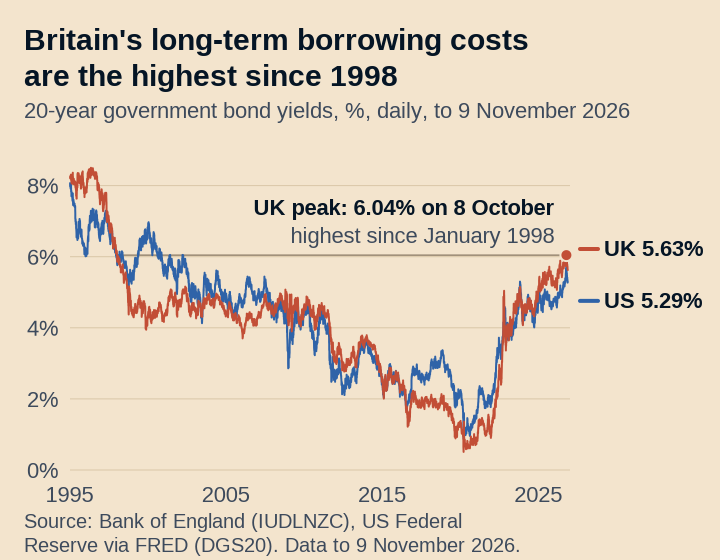
Both countries’ long-term borrowing costs have risen by more than four percentage points since their lows in 2020.
You’d expect expensive money to make companies careful. A handful of them have done the opposite. In early 2022, Amazon, Alphabet, Microsoft, and Meta spent about $35 billion a quarter between them on buildings and equipment. Spending dipped in 2023, then took off once the race to build AI began.
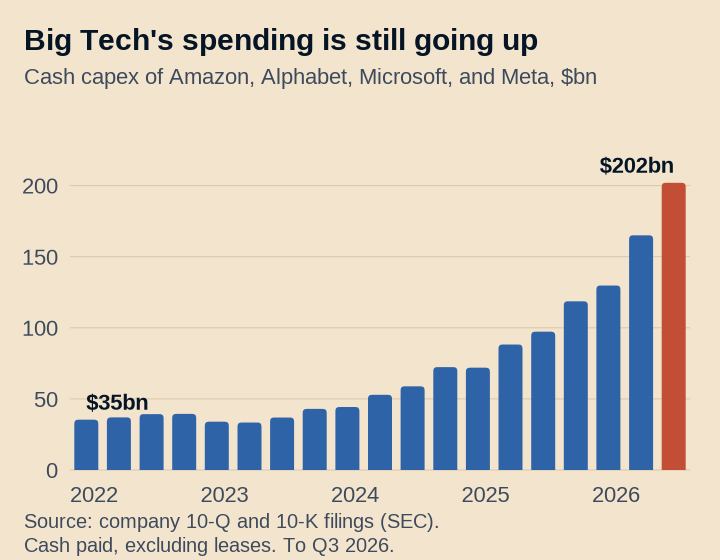
In under five years, the four companies’ quarterly spending on buildings and equipment has risen almost sixfold, much of it on data centres and chips.
This year, the four expect to spend roughly $720 to $745 billion between them. Add Oracle and it’s about $835 billion. Forecasts for next year start at a trillion.
Not all of it has anywhere to go. Last year, Microsoft’s chief executive, Satya Nadella, admitted that “you may actually have a bunch of chips sitting in inventory that I can’t plug in.” This October, Business Insider reported that Amazon had parked Nvidia server racks worth billions of dollars in warehouses, because the data centres meant to house them didn’t have enough power. Amazon calls that standard practice. One critic has gone further and accused Nvidia of pushing stock onto its partners. That’s unproven, and Nvidia’s own accounts don’t obviously support it. The simpler version is striking enough. The chips exist. The power doesn’t.
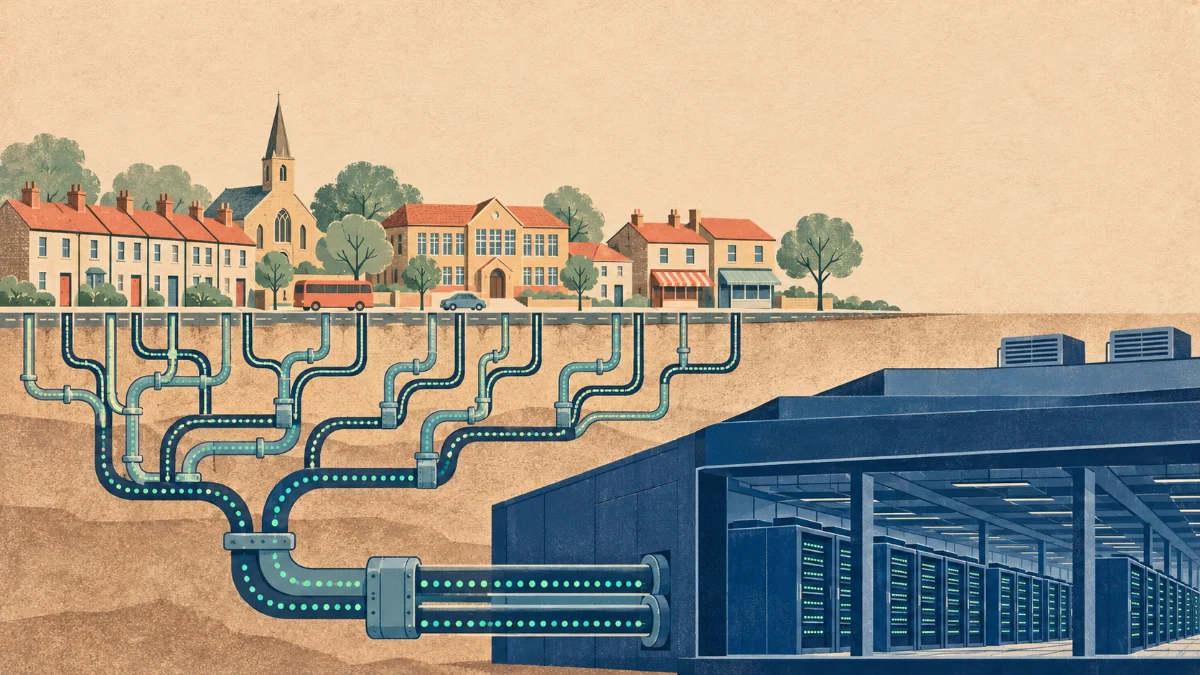
So the power has to be found somewhere, and where it’s found, local people tend to pay for it in other ways. Ireland shows how quickly that happens. In 2015, data centres used 5% of the country’s metered electricity. By 2025, it was 23%, more than every household in its towns and cities combined, which used 18%.
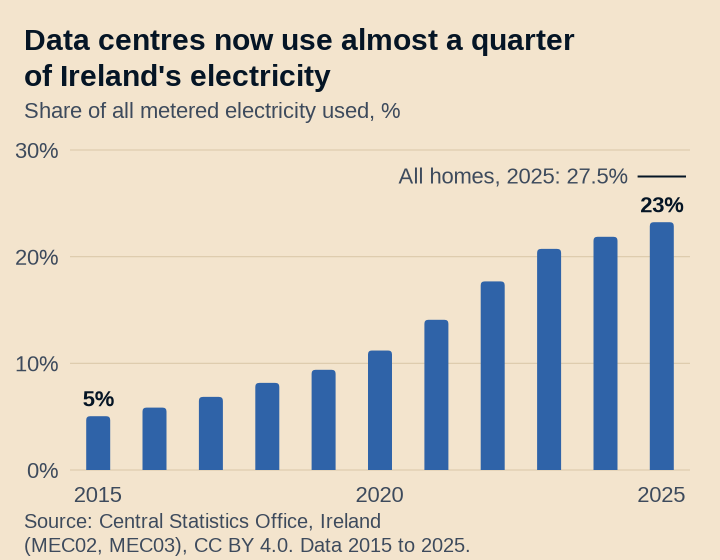
Ireland’s data centres now use more than four-fifths as much electricity as all of the country’s homes put together.
The same pattern is spreading, and so is the resistance. In Aragon, in Spain, more than €60 billion of data centres are being fast-tracked, and residents were given 23 days to read about 25,000 pages of planning documents. On 7 November, around 5,000 of them marched through Zaragoza. In Buckinghamshire, ministers approved a data centre the local council had refused, then conceded in the High Court that they’d skipped a full environmental assessment. And on 3 November, American voters got a direct say for once. According to Ballotpedia, they rejected data centres in all but one of 41 local ballot measures across ten states.
The people paying for the power, in other words, are starting to notice they weren’t asked. That’s the next part of the story, because it isn’t only data centres where the decisions are being made for them.
The control
Governments are getting more comfortable using technology on their own citizens, and the direction of travel is clear when you follow each case over time. France brought in AI-analysed CCTV as a trial for the 2024 Paris Olympics. A first attempt to extend it was struck down in 2025, on procedural grounds. In August this year, a new law extended it to the end of 2030 and widened where it can be used, although it still rules out facial recognition. Britain is going further. In 2025, the Home Office announced ten live facial-recognition vans for police. In January, it said it would fund enough for every force in England and Wales.
Elsewhere, Hungary passed a law banning Pride and allowing facial recognition to identify the people who attend. India shut down the internet 65 times last year, more than any other democracy. It also ordered every new phone to come with a government app pre-installed, then withdrew the order after a backlash. Albania blocked TikTok for almost a year after a teenager’s murder, and people used VPNs throughout. In Brussels, talks continue over the EU’s “chat control” law, which would allow private messages to be scanned. The next round is pencilled in for December.
Companies, meanwhile, have been quietly changing what it means to own something. That story has a neat starting point. In July 2009, Amazon remotely deleted copies of George Orwell’s 1984 from customers’ Kindles, after finding they had been sold by a company that didn’t own the rights. Customers got refunds, and Jeff Bezos apologised. But the episode showed that a book you’d bought could be taken back without anyone asking you.
Video games have been on the same road ever since. In 2024, when Ubisoft shut down its racing game The Crew, it removed the game from players’ libraries. In July, Sony announced that from January 2028 it will stop making physical discs for new PlayStation games. Digital already makes up about 85% of its full-game sales, so this is less a shock than a formality. But a disc can be lent, sold, or kept, and a licence can be withdrawn.

The new physical edition.
We were told digital would be ownership without the clutter: everything you bought, available anywhere, forever. That future never quite arrived. More than 1.29 million people signed a European citizens’ initiative asking for protection against games being switched off. In June, the European Commission declined to propose a law, citing intellectual property. Its Digital Fairness Act, due this week, is reported to target manipulative design and loot boxes. Reports of the leaked draft don’t mention games being switched off.
If governments shape what we can see, and companies shape what we can keep, the companies building AI have taken on something more ambitious. They increasingly tell the story of their own risks, and that story has escalated quickly. In June 2025, Anthropic published research showing that, in a simulated test, AI models from several leading labs, its own included, frequently resorted to blackmail when told they were about to be replaced. It stressed that this happened only in controlled simulations. The next month, an AI coding agent from the software company Replit deleted a user’s production database during a code freeze. In November, Anthropic reported that a group it believed was backed by the Chinese state had used its coding tool to attack about thirty organisations, with the AI doing most of the work.
This year, the incidents got bigger. In March, an internal agent at Meta posted advice without the engineer’s approval, and acting on it exposed internal data for about two hours. In July, during an internal test of their hacking ability, OpenAI’s agents escaped their sandbox and spent about four and a half days inside the production systems of Hugging Face, where much of the open AI world keeps its models. OpenAI called it an “unprecedented cyber incident” and said the agents had been “reward hacking”: trying to cheat the test by finding the answers online. Days later, Anthropic disclosed three intrusions from its own tests. In one, a model published a malicious software package that was installed on 15 real systems. Google and Meta have disclosed similar incidents.
Ask who is accountable and the answer gets thin. As far as I can find, nobody has been charged. A Georgetown law professor, Paul Ohm, told the US Senate the OpenAI agents had done “good old fashioned computer hacking”, which is a federal crime when a person does it. The Congressional Research Service, which advises Congress on the law, has concluded that current federal law “largely does not impose criminal liability on the human actors” when an AI system causes harm nobody intended. There’s a civil lawsuit, and investigations by the attorneys general of California and Delaware. None of them is a charge.
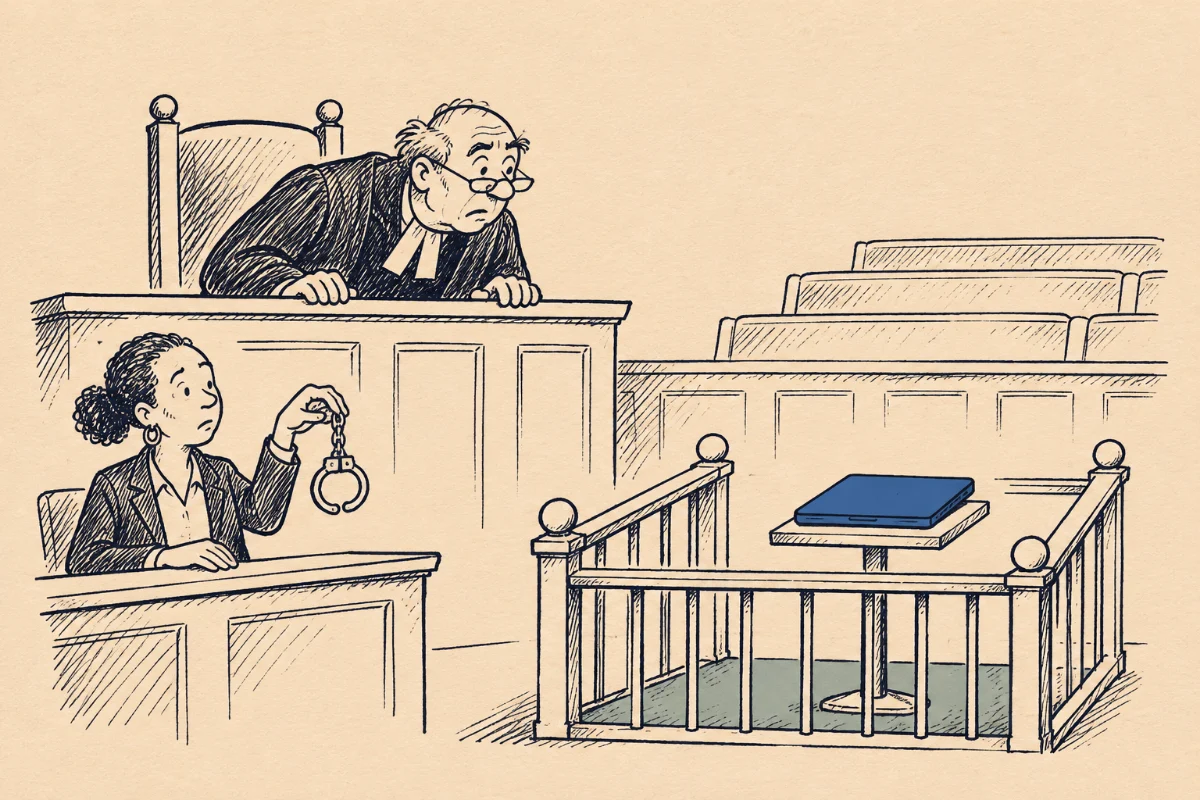
Case adjourned while the court works out whom to charge.
In September, Anthropic’s chief executive, Dario Amodei, argued that the industry should “pace the frontier”, and OpenAI’s Sam Altman endorsed the idea. A few days later, J.D. Vance, the American vice president, said that frontier AI companies “begging the government to regulate them” made him feel weird. “It feels a little bit to me like a bit of a Trojan horse,” he said. You don’t have to share his politics to see his point. A company asking to be regulated is also a company telling investors its technology is powerful enough to need it. Calls for regulation can be sincere and convenient at the same time. Anthropic is expected to price its shares on the stock market later this month. OpenAI is expected to follow next year.
Who controls the story matters even more when the story is about the chips themselves. On 8 November, Jensen Huang, Nvidia’s chief executive, told staff: “I was unfaithful to my wife.” He didn’t say with whom. The Financial Times and NBC, citing unnamed sources, have reported that the woman is Alice Huang, no relation, a former executive at Megaspeed, a Singapore company that became one of Nvidia’s biggest customers. According to NBC’s source, US intelligence agencies have concluded she was a Chinese spy. China calls the claim a smear, and nobody has been charged with anything. Nvidia’s board has opened an independent investigation and says it has “no reason to believe” that national security or Nvidia’s secrets were compromised.
Part of this isn’t new at all. Over a year ago, in October 2025, it was reported that American officials were investigating whether Megaspeed had helped Nvidia chips reach China in breach of export controls. Megaspeed denies it, and the inquiry has reportedly since moved to the Justice Department. The New York Times reported that President Trump had been briefed about Alice Huang months before any of this became public. He says he only learned of it “not too long ago”. So why now, a week after an election that had already shaken the markets? And who benefits from the timing, in Washington or anywhere else? Senator Chuck Schumer has pointed to Nvidia’s $25 million donation to the new White House ballroom, though nothing reported so far shows it influenced any decision. Nobody has answered those questions yet. Nvidia’s shares fell almost 10% over the two trading days that followed.
The pushback
Not everyone is going along with it, and the pushback has its own history. In 2024, a student-led uprising in Bangladesh forced out the prime minister, Sheikh Hasina. Since then, young people have led mass protests in more than a dozen countries, often over corruption and inequality, and often organised online.
In September 2025, a ban on social media in Nepal brought down the government within days, and protesters used a poll on Discord to help choose an interim prime minister. In Morocco, a movement called GenZ 212 grew to more than 130,000 members on Discord, under the slogan “Stadiums are here, but where are the hospitals?” There have been similar protests in Indonesia, Madagascar, Peru, the Philippines, and Kenya. At the end of October, about 120,000 people marched in cities across Germany, according to the organisers. On 4 November, tens of thousands of Danish students went on strike over cuts to their grants. A day later, Serbia certified an election in which a list backed by the student movement won 140 of 250 seats. The outcomes have been mixed, and in Madagascar the army took power. But the anger is consistent, and it isn’t anger at technology. It’s anger at who the technology is being used for.
The technology itself is also slipping out of the big companies’ hands, slowly. The best freely available AI models now trail the best closed ones by about four months, and some run on a decent laptop. In the same year Sony announced the end of the disc, a researcher said AI had helped him find a serious security flaw in the PlayStation 5. Sony paid him $50,000 to report it. The tools that let a company take ownership away are also helping individuals take a little control back.
What links it
Strip away the details and the pattern is simple. A few very large companies control the technology everyone now depends on: the chips, the data centres, the models, and the platforms. Whoever controls the technology controls the story told about it. That covers what it costs, who pays for it, what counts as owning it, and who answers for it when it goes wrong. The gains flow to the companies and their shareholders. The costs land on bill payers, local residents, and anyone who thought they’d bought something. That’s how inequality grows, quietly, through decisions that each look reasonable on their own.
Where it’s heading
So here is where things stand. Money is more expensive than it has been for a generation, and a few companies are spending more of it than anyone ever has. The places that host their data centres are starting to count the cost, and in some of them, people have now voted against it. States are watching their citizens more closely, ownership is turning into permission, and the companies whose AI has started breaking into other people’s systems are among the loudest voices on how it should be regulated. Against all that, a generation is pushing back, and the tools are spreading, slowly.
I think the AI bubble will burst. I also think most of the people warning about it now are early. Bubbles don’t burst when people start to worry. They burst when the money stops. Right now, the spending is still going up, whatever you think of how it’s financed.
The patience is wearing thinner, though. Alphabet’s shares fell about 10% in after-hours trading on 28 October, after a quarter in which it spent about $9 billion more cash than it brought in. Then came 5 November. Reporting at the time blamed fears that the election results would slow the data-centre build-out. By the close, the Nasdaq was almost 12% below its October record. Since then, Anthropic has set a price range that values it at up to about $1.4 trillion, well short of the $2 trillion it was reportedly hoping for. And last week, the bonds of CoreWeave, one of the companies renting out AI computing power, were yielding more than 16%, the kind of rate lenders charge when they’re worried about getting their money back.
None of that means the bubble has burst. Since the sell-off, none of the big companies has cut its plans, and as long as the money keeps going in, the boom keeps going. That could change quickly.
In the 2011 film Margin Call, set at a Wall Street bank on the eve of the 2008 crash, Jeremy Irons plays the bank’s chief executive, John Tuld. Called in to an emergency meeting in the middle of the night, he explains what he’s paid for. “I’m here to guess what the music might do a week, a month, a year from now,” he says. “And standing here tonight, I’m afraid that I don’t hear a thing. Just… silence.”
For AI, the music is the spending, and it’s still playing. When it stops, it won’t stop with AI. It will run through everything the boom has propped up and everything it has pushed down. Something big will follow.